

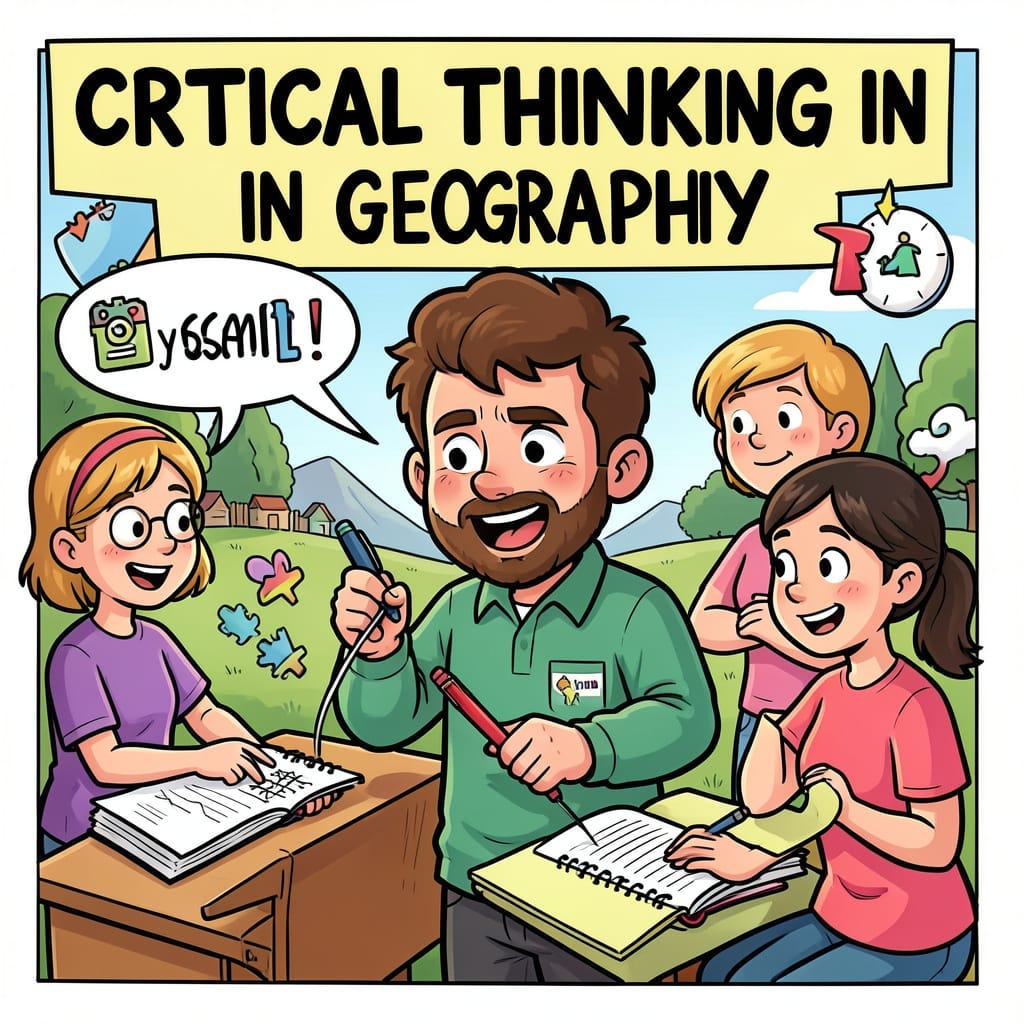
Critical Thinking in Geography

Critical thinking in geography means slowing down, asking sharp questions about places and patterns, and using evidence and logic (not just opinions) to reach a better conclusion.
What is critical thinking?
Critical thinking is the ability to stop, think carefully, and decide what to believe or do using facts, evidence, and clear reasoning. It is not about being negative, arguing for the sake of it, or just having “strong views.”
When you think critically, you:
Identify the main claim (what is actually being said).
Look for evidence and check how strong it is.
Notice what is missing or ignored, including other viewpoints.
Decide what would make you change your mind, and stay open to that.
In geography, this helps you move beyond memorising facts to explaining patterns and making reasoned judgments.
A simple 4‑step process
You can use this clear process in any geography task:
What is the claim?
Example: “Deforestation in the Amazon is mainly caused by cattle ranching.”
What is the evidence?
Check maps, graphs, satellite images, and articles: do they show large areas cleared for pasture, or for other uses like soy farming or logging?
What is missing or ignored?
Are other causes (e.g. roads, mining, small-scale farming) mentioned?
Who gains (e.g. large companies, national government) and who loses (e.g. Indigenous communities, global climate)?
What would change my mind?
For example: “If new data showed that most recent forest loss is from mining, not ranching, I would update my conclusion.”
If you cannot say what would change your mind, you are defending a position, not thinking critically.
Why geography needs critical thinking
Geography is more than maps and place names; it is about the “whys of where” – why things are located where they are, and how places are connected. Critical thinking in geography means making sense of spatial patterns, questioning sources, and linking local places to global processes.
It helps you:
Spot weak or biased arguments about the environment, migration, or cities.
Evaluate graphs, maps, and news stories, instead of just accepting them.
Make better decisions about real issues like climate change, resource use, or housing.
Adapt to new information and changing conditions, which matters for future jobs.
Geographers argue that the subject is “nothing without” critical thinking because enquiry and questioning are at its heart.
Geography examples you can use in class
Here are three concrete examples that show what critical thinking looks like in geography:
1. Urbanisation and megacities
Claim: “Megacities are always a sign of economic success.”
Evidence: Use data on GDP, informal settlements, unemployment, and quality of life in cities like Lagos, Mumbai, and Tokyo.
What is missing: Consider problems such as slums, congestion, pollution, and inequality alongside growth in jobs and services.
Critical conclusion: Some megacities show both opportunity and serious challenges, so they are not “always” successful; the picture varies by city and by group of people.
2. Climate change and extreme weather
Claim: “Every flood is caused by climate change.”
Evidence: Look at rainfall records, land use (e.g. deforestation, urbanisation), river management, and long-term climate trends for a region.
What is missing: Human factors like building on floodplains, poor drainage, and loss of wetlands may also increase flood risk.
Critical conclusion: Climate change can increase the likelihood and intensity of some floods, but local human decisions often play a big role too.
3. Globalisation and fast fashion
Claim: “Fast fashion is good because it gives people cheap clothes and jobs.”
Evidence: Study maps of supply chains, data on wages and working conditions, and environmental impacts such as water use and pollution.
What is missing: Consider who benefits (big brands, some consumers) and who bears the costs (factory workers, local environments, future generations).
Critical conclusion: Fast fashion brings some benefits (jobs, low prices) but also serious social and environmental costs; a thoughtful judgment needs both sides.
In each case, the key is not to memorise an official answer, but to build your own reasoned view from evidence.
How you can practise critical thinking in geography
You can turn almost any geography activity into critical thinking practice by changing the questions you ask.
Try these strategies:
When you see a map or graph, ask: “What patterns do I see? What might explain them? What don’t I know yet?”
When you read a case study, ask: “Whose perspective is this? Who is missing from the story?”
When you hear a confident claim (in class, on social media, or in the news), ask: “What evidence is given? How reliable is it?”
For every conclusion you write, add: “This could change if…”, and state what new evidence would make you rethink.
In a world full of data, opinions, and AI‑generated information, geography gives you daily chances to practise critical thinking and become the kind of person who can ask better questions and make better decisions.
Critical Thinking Questions for Mapwork
Here are example critical thinking questions you can ask students when they work with different kinds of geography maps. You can adapt the place names and scales to your own case studies.
General map-reading and interpretation
What is this map trying to show most clearly, and how do you know (title, key, symbols, colours)?
Who do you think made this map, and for what purpose? How might that affect what is included or left out?
Which parts of the map are shown in the most detail, and which are more general? Why might the cartographer have made that choice?
What questions do you still have after looking at this map? What extra information would you need to answer them?
The “whys of where” (spatial patterns)
Where are the main clusters and gaps on this map (e.g. of population, rainfall, earthquakes)? Why might those patterns exist?
How are different features related in space? For example, how do rivers, roads, and settlements seem to link together? What might explain these relationships?
Are any features overlapping or very close together (e.g. factories and rivers, ports and large cities)? What possible conflicts or opportunities could that create?
If you changed one feature on the map (e.g. built a new motorway, dam, or port), which other features would be affected, and how?
Physical maps and topographic maps
How might the relief (steep slopes, flat plains, valleys) shown by contours or shading affect farming, transport, or settlement in this area?
Where would be the safest place for a new settlement or road, based on elevation, rivers, and slopes? Justify your choice with map evidence.
Looking at the direction and pattern of rivers, how might flooding risk vary across this area? Which locations appear most vulnerable, and why?
How might a change in climate (e.g. more intense rainfall) affect the physical landscape shown on this map over time?
Political and thematic maps (population, climate, elections, etc.)
How does the map’s choice of colours, symbols, or categories influence the message it sends (for example, in a population density or election map)?
What stories about this place might this map encourage you to believe, and what stories might it hide or ignore?
Compare two maps of the same place (e.g. climate zones and population density). Where do patterns match or clash, and what could explain that?
If you were a business/government/NGO planning a project, how would this map help you choose a location? What important information is missing?
Change over time (map sequences)
Comparing these two maps of the same area from different years, what are the main changes in land use or settlement? Which change do you think is most significant, and why?
What might have caused these changes (e.g. economic growth, conflict, new transport routes, environmental policy)? Which causes seem most likely?
Who might benefit from the changes shown, and who might lose out (e.g. local communities, businesses, wildlife)?
If current trends on these maps continue for another 20 years, what might this area look like? What evidence supports your prediction?
Critical questions about sources and reliability
What scale is this map? Which kinds of questions can it answer well, and which questions is it too coarse or too detailed to answer confidently?
Are there any obvious biases or gaps (e.g. some regions mapped in detail, others blank or simplified)? What impact could that have on decisions based on this map?
How might the map look different if it were made by local residents instead of a national government or company?
What other sources (photos, fieldwork, census data, GIS layers) would you combine with this map to check how accurate and up to date it is?
You can turn many of these into stems for students to complete (e.g. “The map suggests that… However, it does not show… This matters because…”), encouraging them to move from simple description to explanation, evaluation, and judgement.
If you would like to support my resources Buy me a Coffee
or one of my inexpensive books at
Ritchie’s Books
Urban and Industrial Geography
If you would like to support my resources scan the QR code below and Buy me a Coffee

A clear format to this, thanks. I think the 4 step process is very useful. Some years ago I marked the Critical Thinking exam paper that the exam board OCR had. The mark scheme was so rigid... right v. wrong... that I ended up falling out with the Principal Examiner. Seemed to undermine the whole purpose of the exam. I didn't mark it again.